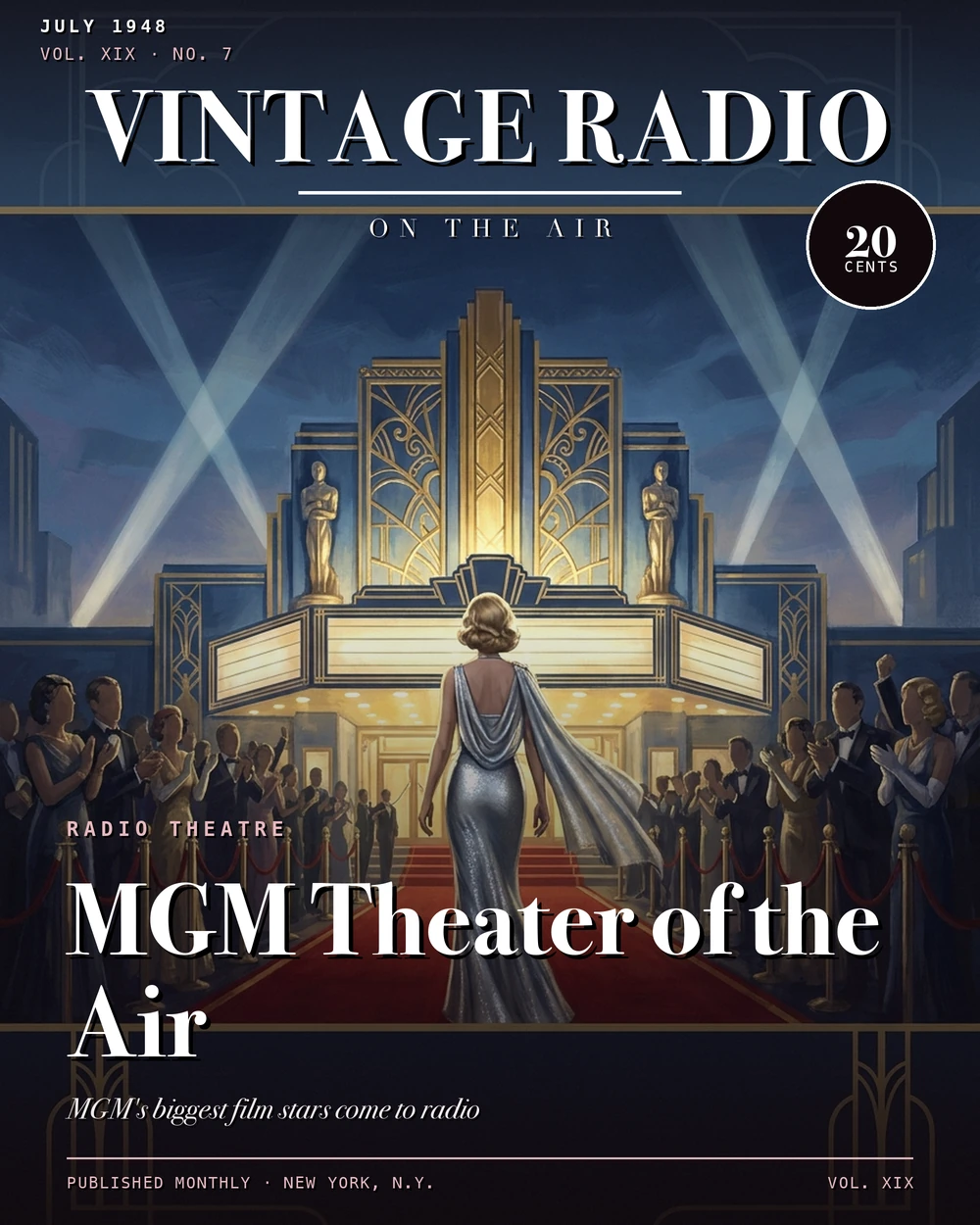
MGM Theater of the Air
Hollywood Comes to Radio
For most of its history, Metro-Goldwyn-Mayer kept its distance from radio. The studio had famously offered little cooperation to WMGM — its own New York flagship station, formerly WHN — "thruout the years," as Billboard noted in 1949 when the new show was announced. What changed was falling movie attendance in the postwar years, and a calculation that radio could do what movie advertising alone could not: put real MGM stars in front of a mass audience every week. The MGM Theater of the Air was the flagship of that turnaround — a 60-minute dramatic anthology built around the studio's film library and the biggest names on its roster.
The show premiered on WMGM on October 14, 1949, distributed through syndication on electrical transcription to stations around the country. WMGM, which had taken its new call letters on September 15, 1948 to reflect Loew's ownership of MGM, billed itself as "The Call Letters of the Stars" — a tagline that station identifications made literal. Transcribed discs of MGM contract players delivered the IDs, with Robert Taylor's voice, for instance, telling listeners they were tuned to "the call letters of the Stars, WMGM, 1050 on your dial, New York."
The Package Behind the Show
MGM Theater of the Air didn't arrive alone. It was the centerpiece of a larger venture called Metro-Goldwyn-Mayer Radio Attractions, which launched September 1, 1949, and bundled eight programs available to stations of all sizes. The full package ran roughly six hours of air time per week and included The Story of Dr. Kildare, The Adventures of Maisie, Crime Does Not Pay, and The Hardy Family, among others. Production and talent costs for all eight programs were initially estimated at close to $1,500,000 per year — a figure that signaled MGM was treating this as a genuine business, not a promotional sideline.
The industry noticed. Within a few days of the initial announcement, between 150 and 200 stations sought information about the package. A reviewer of an early episode wrote that "in slickness of production this hour-long program compares very favorably with many of its network brothers." A 1950 trade description called it a "Big time production ... featuring adaptions of MGM and other screen properties with top-ranking names of screen and theater." The syndication model meant individual stations didn't always broadcast episodes in sequence — airing dates varied, and program order wasn't fixed — but the quality of the productions themselves was consistent enough to hold interest.
The first season ran at least 26 episodes. By April 1950, demand was strong enough that MGM produced another 26 weeks, giving the initial run a full 52-episode season.
Who Ran It and How
The show operated with a rotating cast by design: no regulars in the lead roles, just a different film star each week matched to that week's adaptation. Ronald Reagan, Joan Bennett, and Marlene Dietrich were among the leads, along with George Murphy, Nina Foch, Rex Harrison, Mickey Rooney, and Melvyn Douglas. In some cases, the radio version starred an actor who had appeared in the original MGM film being adapted. The lion's share of the production budget went toward securing that week's big name, with the remaining ensemble drawn from experienced radio performers — Les Tremayne, John Gibson, Gertrude Warner, Sarah Fussell, Frank Behrens, Chuck Webster, Kermit Murdock, and Carl Eastman among them.
Howard Dietz, MGM's Vice President in Charge of Publicity since 1942, hosted the series. Dietz was a significant figure in American entertainment well beyond his studio role: a lyricist and librettist best known for his decades-long songwriting partnership with composer Arthur Schwartz, and the man credited with creating MGM's Leo the Lion mascot and choosing the studio's Latin motto Ars Gratia Artis — "Art for Art's Sake." When Dietz was unavailable, Carey Wilson substituted as host. Ed Stokes was the announcer, with Bob Williams backing him up. Raymond Katz produced the series, Marx B. Loeb directed, and Joel Herron — who served as music director at WMGM for roughly ten years — conducted the music.
The show's conceptual model was drawn from Lux Radio Theatre, the long-running anthology that had made a business of adapting Hollywood films for the air. MGM Radio Attractions was built in part to duplicate that success, and the comparison was favorable enough to draw strong early industry attention.
The Mutual Years
The syndication run ended December 7, 1951. On January 5, 1952, MGM Theater of the Air moved to the Mutual network, airing Saturdays at 8:30 and keeping its 60-minute format. It was one of ten MGM programs that joined Mutual simultaneously — the others included Woman of the Year, Crime Does Not Pay, The Black Museum, The Story of Dr. Kildare, MGM Musical Comedy Theater of the Air, The Modern Adventures of Casanova, The Gracie Fields Show, The Adventures of Maisie, and The Hardy Family.
Mutual mounted "an extensive promotion campaign" for the new arrivals, including boxes of gingerbread men shaped like Mutual's "Mr. Plus" trademark and MGM's Leo the Lion, distributed to advertisers, agencies, and radio editors. Despite the fanfare, MGM Theater of the Air lasted only one year on the network. The final episode aired December 27, 1952.
What Survives
The episodes that have been preserved give a reasonable picture of how the series worked in practice. Documented adaptations include films as varied as "Anna Karenina," "Queen Christina" (with Basil Rathbone and Lilli Palmer), "Johnny Eager," "The Citadel," "Slightly Dangerous," "Reckless" (starring June Havoc), and "Third Finger, Left Hand" (with Melvyn Douglas and Arlene Francis). "Dramatic School" paired Martin Gabel with Luise Rainer; "Design for Scandal" brought Ralph Bellamy to radio alongside Arlene Francis. The range of titles reflects the breadth of MGM's film library and the show's willingness to pull from different eras of studio output rather than only adapting recent releases.
Howard Dietz, who gave the show much of its on-air identity, went on to be inducted into the Songwriters Hall of Fame in 1972 and into the American Theatre Hall of Fame in 1981. He died on July 30, 1983. His archive — career documents, MGM publicity materials, correspondence — was donated to the New York Public Library for the Performing Arts, where it became the library's single largest archive on any individual or subject. The show he hosted was a relatively brief chapter in a long career, but it marked a genuine pivot in how MGM thought about radio: less a medium to resist, and more a stage large enough for the studio's stars.